The 7 honest options for a European System that isn’t working for voters
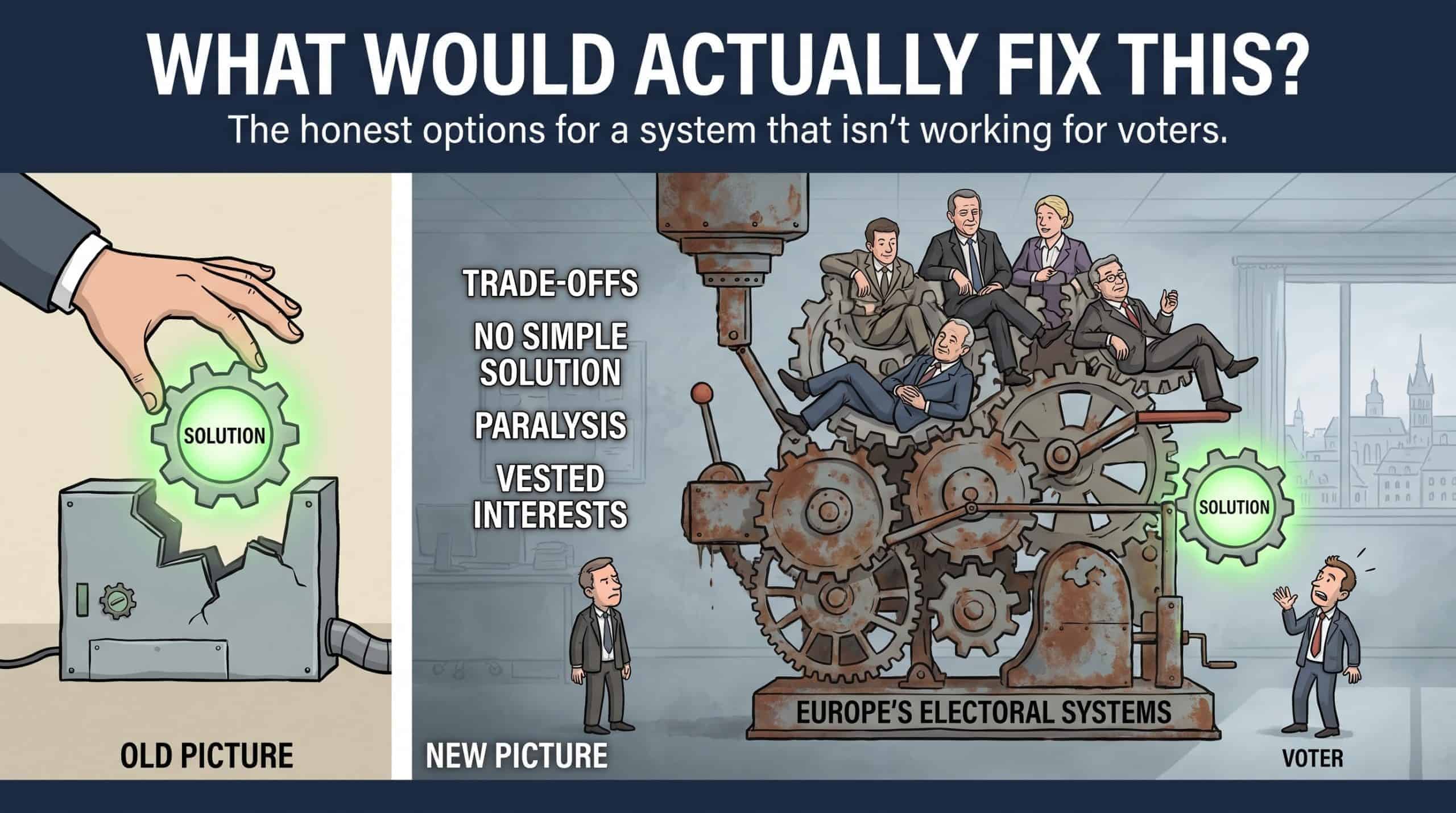
Stockholm, Sweden – Think of the old picture of fixing a problem. You identify what’s broken. You find a solution. You implement it. The problem goes away.
Now picture the new picture. You identify what’s broken. You find a solution. But the people who would have to implement it are the people who benefit from the problem. They have no incentive to change anything. So the problem stays.
This is where we are with Europe’s electoral systems. The problems are known. The solutions exist. The will to change is almost entirely absent.
This article is not a wish list. It is not a fantasy of a perfect system. It is an honest look at what could be done – and what it would cost.
The honest truth
There is no fix that makes everyone happy. Every change to an electoral system trades one problem for another.
Positive parliamentarism makes governments harder to form.
Lower thresholds make parliaments more fragmented.
Direct Prime Minister PM elections make cohabitation crises more likely.
Anyone who tells you there is a simple solution is selling something.
But that does not mean nothing can be done. It means we should be honest about the trade-offs.
Option 1: Positive parliamentarism
What it is:
In Sweden, a prime minister only needs fewer than 175 votes against them. Abstentions count as support. This is called negative parliamentarism. Under positive parliamentarism, a PM would need a majority of votes for them.
The case for it:
A government would have active, declared support from a majority of parliament. No more governments tolerated by abstention. No more PMs approved with 115 votes. Voters would know who is responsible for the government.
The case against it:
Sweden has had stable governments precisely because the bar is low. Raising it could mean months of deadlock, repeated failed votes, and snap elections.
Belgium once went 541 days without a government. Spain has had repeat elections because no one could command a positive majority. Stability has a cost. So does instability!
What Sweden hasn’t tried:
Positive parliamentarism. It is the single biggest change Sweden could make. It is also the one most likely to produce paralysis.
Option 2: Lower or scrap the threshold
What it is:
Sweden’s 4 percent threshold means parties below it get zero seats. Germany’s is 5 percent.
The case for it:
Every vote would count. No more discarded ballots. The BSW’s 4.97 percent in Germany would have won 34 seats. The 9,523 voters who missed by a whisker would have representation.
The case against it:
More parties means more fragmentation. More fragmentation means harder coalitions. Israel has no threshold and constant instability. Germany’s threshold exists because Weimar’s chaos helped destroy the republic. Stability is not free.
What Sweden hasn’t tried:
A lower threshold – say 2 percent. This would let smaller parties in without completely fragmenting parliament. Denmark has a 2 percent threshold and manages to govern. It is possible!
Option 3: Citizens’ assemblies
What it is:
Randomly selected citizens, balanced by demographics, deliberate on issues and make recommendations. Ireland has used them for constitutional changes. France used one for climate policy.
The case for it:
Ordinary people, not politicians, would shape solutions. It would bypass party interests. It could rebuild trust between voters and the system.
The case against it:
Citizens are not experts. Their recommendations are not binding. Politicians can ignore them. And they do not solve the structural problem of coalition formation.
What Sweden hasn’t tried: A national citizens’ assembly on electoral reform. It could happen. It probably won’t.
Option 4: Recall vote
What it is:
Voters can remove an elected official before their term ends by petition and vote.
The case for it: Politicians would be accountable between elections. Broken promises would have consequences.
The case against it: Sweden has no recall mechanism. Introducing one would require constitutional change. And it could be weaponized by well-funded interests to harass politicians.
What Sweden hasn’t tried: Any form of recall. It is not part of the Swedish tradition.
Option 5: Referendums
What it is: Voters decide directly on specific issues.
The case for it:
On major questions, voters would decide, not parties. Switzerland uses referendums constantly and has high trust in government.
The case against it:
Referendums can be manipulated by money and misinformation. UK’s Brexit is the cautionary tale. They also do not solve the coalition problem – they bypass it on single issues.
What Sweden hasn’t tried: More frequent referendums. Sweden uses them rarely. Some parties want more. Others fear them.
Option 6: Open primaries
What it is:
Voters, not party elites, choose candidates. The US uses primaries. Sweden uses party-controlled lists.
The case for it:
Party leaders would lose control over who gets seated. Voters would have a direct say in who represents them.
The case against it:
Primaries can produce more extreme candidates. They cost money. And they do not solve the coalition problem – you could still end up with a government you did not choose.
What Sweden hasn’t tried:
Open primaries. The party list system is deeply entrenched.
Option 7: Direct PM elections
What it is:
Voters choose the prime minister directly, like France’s president or Israel’s brief experiment with direct PM elections in the 1990s.
The case for it:
Voters would know who they are choosing. No more post-election deals deciding the leader. The PM would have a personal mandate.
The case against it:
Israel tried this and abolished it after a decade. It created a split between the directly elected PM and the parliament, making governance harder.
France’s semi-presidential system produces cohabitation crises. Direct elections do not solve coalition math.
What Sweden hasn’t tried:
Direct PM elections. It would require a fundamental constitutional overhaul.
The voter who says “just give us the choice”
Meet Erik (not real name). He is 44. He lives in Uppsala. He voted for the Sweden Democrats in 2022. He is not sure he will vote at all in 2026.
“I voted for change,” he says. “I got a government that depends on the party I voted for but won’t admit it. I got a prime minister who says one thing and does another. I got a system where my vote counts for seats but not for power.”
He is frustrated. But he is not confused.
“Just give us the choice,” he says. “Let us vote for a government. Let us vote for a prime minister. Stop making us vote for pieces and then letting someone else assemble the puzzle.”
He knows it is not that simple. He knows coalitions are necessary. But he wants the system to stop pretending.
The honest question
Every option above has costs. Every one trades one problem for another. There is no perfect system. There never was.
But here is the question that matters: if the system is changeable – and it is, all of these options are possible – why doesn’t anyone change it?
The answer is not complicated. The people who would have to change the rules are the people who benefit from the rules.
The parties in parliament set the threshold. The parties in power design the system. The elites who negotiate coalitions are the elites who would lose power if coalitions became more transparent.
The system is not broken. It is working as designed. The design just does not prioritize what voters think it prioritizes.
Back to the old and new pictures
So we return to our two pictures of fixing a problem.
In the old picture, problems get solved. You identify what is broken. You fix it. The system evolves. Democracy improves.
In the new picture, problems get managed. You identify what is broken. You acknowledge it. You debate it. You do nothing. The people who benefit from the problem are the people who decide whether to fix it.
Sweden votes today. The polls are too close to call. The left bloc leads by a whisker. The right bloc is fighting to hold on.
The Sweden Democrats are demanding cabinet seats. The Liberals are surging on ‘tactical’ votes but in a ‘strange’ eye-brow raising way, days before elections today 13 September 2026.
Whatever happens, the government that emerges will be built through the same system that produced the last one. The system is not on the ballot. It never is.
The question is not whether the system can be fixed. It can. The question is whether anyone with power wants to fix it!
The answer, so far, is a clean ‘NO’!!!
Next Article in series: You Voted. Someone Else Chose. How Europe’s system turns your ballot into a starting position.
Other articles in the series: Is ballot democracy still democracy?
When the voters cast their ballots however, it’s the seats and blocs that count in parliament…Not forgetting closed door negotiations for government formation, and a PM whom in some cases ended up being an unelected civil servant.
All articles in the series including the editorial explain the pertinent questions like the why and how’s and present a solution to the question of democracy through electoral voting in some European nations.
Hope you find them of any help… and that would make us at EuroContinentalDispatch.com(The voice of the unheard majority on the European continent) glad!
https://eurocontinentaldispatch.com/articles/the-firewall-when-everyone-agrees-to-ignore-millions
https://eurocontinentaldispatch.com/articles/the-promise-they-broke
https://eurocontinentaldispatch.com/articles/the-4-the-5-and-the-votes-that-vanish
https://eurocontinentaldispatch.com/articles/what-would-actually-fix-this
https://eurocontinentaldispatch.com/articles/sweden-votes-tomorrow-will-it-be-2022-all-over-again
https://eurocontinentaldispatch.com/articles/you-voted-someone-else-chose-how-europes-system-turns-your-ballot-into-a-starting-position
https://eurocontinentaldispatch.com/articles/the-quiet-robbery-why-your-vote-keeps-losing-to-the-fine-print
Leave a Reply