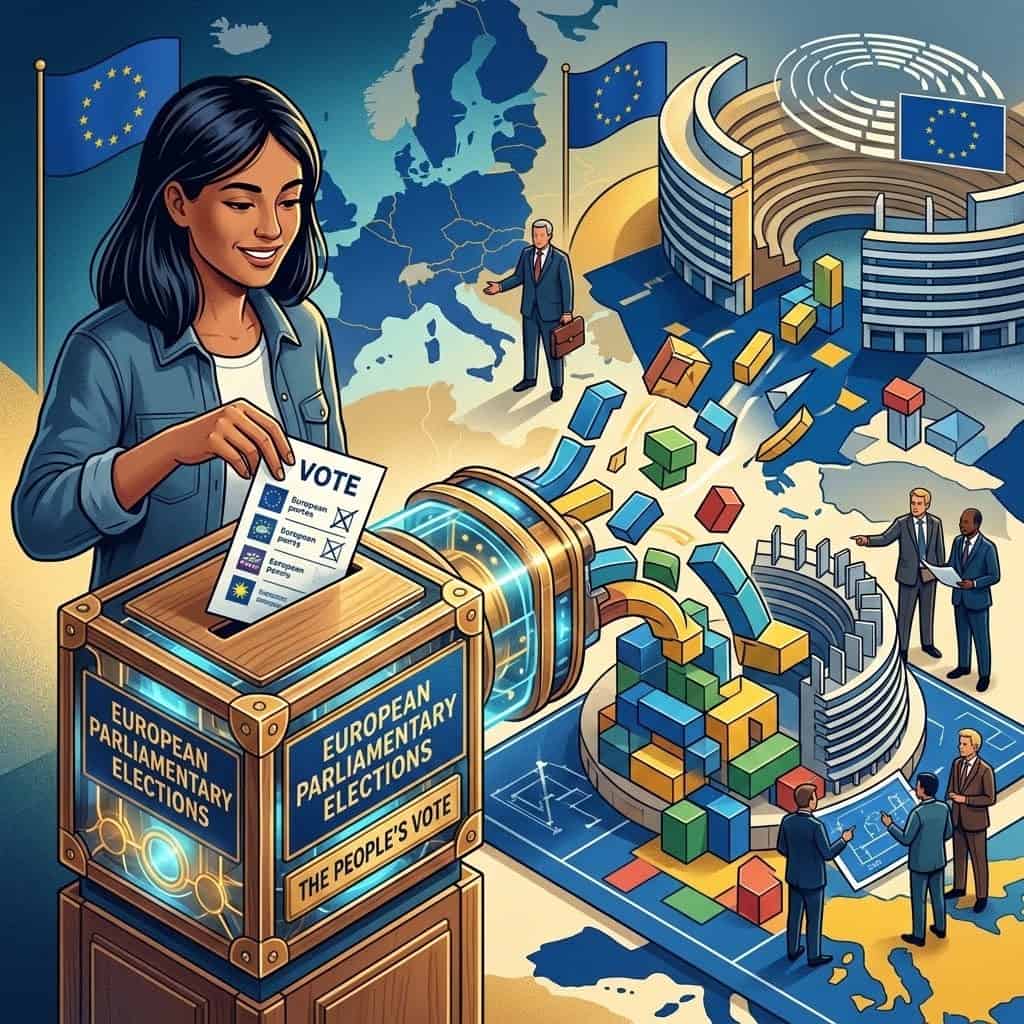
Stockholm, Sweden – You did your part. You read the manifestos. You watched the debates. You ignored the noise. You walked to the polling station on a cold Sunday morning and you cast your vote.
You thought you were picking a government.
You were actually picking a starting position.
This is not a small distinction. It is the difference between a democracy where voters choose their leaders and a democracy where voters choose the raw material that party elites use to build one.
Sweden is the clearest example, and not just because the country votes tomorrow, on September 13 2026 .
The old picture
The old picture of democracy is simple. Parties compete. Voters pick. The winner governs. If you do not like the result, you vote them out next time.
This picture works reasonably well in countries with two parties and single-member districts.
The United Kingdom. The United States. Canada. Not perfectly, but roughly. You vote for a person or a party. One of them gets a majority. They run the show.
Sweden does not work this way. Neither does Germany, France, or the Netherlands. And that is where the trouble starts.
The new picture
In Sweden, you vote for a party. There are eight of them in parliament. None of them will get anywhere near 50 percent. That is not an accident. It is the design.
The 349 seats in the Riksdag (parliament) are allocated proportionally. A party needs 4 percent of the national vote to enter parliament .
Above that line, seats are distributed to roughly match vote share. Below it, your vote vanishes.
In 2022, the Social Democrats won 30.3 percent of the vote and 107 seats . The largest party. The most votes. By any normal definition, the winner.
They went into opposition!!!
The Moderates got 19.1 percent and 68 seats . Less than two-thirds of the Social Democrats’ support. They produced the prime minister.
How? The right bloc – Moderates, Christian Democrats, Liberals, and Sweden Democrats – together won 176 seats.
The left bloc – Social Democrats, Left Party, Greens, and Centre – won 173 . The right had three more seats. Three.
So the “winner” in Swedish politics is not the party with the most votes. It is the bloc with the most seats.
And the bloc is not something voters choose. It is something party leaders negotiate.
The Sweden Democrats problem
Here is where it gets even stranger.
The Sweden Democrats won 73 seats in 2022. Second-largest party. More seats than the Moderates, who took the prime minister’s office .
But every other party had spent years saying the same thing: we will never work with the Sweden Democrats.
They were founded in the 1980s with links to neo-Nazi movements . The other parties treated them like a political plague.
During the 2022 campaign, the Moderates, Christian Democrats, and Liberals all said they would not govern with the Sweden Democrats.
After the election, they signed the Tidö Agreement – a deal that gave the Sweden Democrats formal influence over immigration, crime, and other policy areas in exchange for their support in parliament .
They did not put Sweden Democrats in the cabinet. They kept that promise. But they broke the spirit of it completely.
The party they said they would never work with became the party driving their agenda.
The Moderates got the prime minister’s office. The Sweden Democrats got the policy.
And the Social Democrats, who won the most votes, got nothing!!!
What voters thought they were doing
Ask a Swedish voter what they thought they were choosing in 2022. Most would say some version of this: we are choosing between the left bloc and the right bloc.
We are choosing whether Magdalena Andersson or Ulf Kristersson runs the country.
That is roughly what happened. But the details matter. And the details are where the feeling of robbery comes from!
A voter who backed the Christian Democrats because they liked Ebba Busch’s healthcare promises got a government that depended on the Sweden Democrats.
A voter who backed the Liberals because they believed the party’s promise to never empower the far right got a government that did exactly that.
A voter who backed the Social Democrats because they wanted Andersson to continue as prime minister got opposition.
Nobody cheated. Nobody broke the law. The rules were followed. But the outcome did not match what millions of voters thought they were choosing.
The numbers tell the story
This is not a Swedish peculiarity. It is the structure of proportional representation.
In Germany, the 2025 election gave the conservatives 28.5 percent of the vote. They needed a coalition partner.
The far-right AfD came second with over 20 percent . Every other party refused to work with them.
So the conservatives formed a grand coalition with the Social Democrats – the party that had just suffered its worst defeat in decades. The second-place voters got zero influence.
In France, the 2024 snap election gave the left-wing New Popular Front the most seats. President Macron refused to appoint a prime minister from their ranks. He chose a conservative from a party with 47 seats instead.
The government collapsed within months. Then another one formed. France has burned through four prime ministers while the winning coalition watched .
In the Netherlands, Geert Wilders won the most seats in 2023. He could not find coalition partners willing to work with him.
When he finally assembled a four-party coalition, he gave up the prime minister’s job to an *unelected* civil servant named Dick Schoof just to get the deal over the line .
The government collapsed in under two years.
The machine is not broken
Here is the part that makes voters angriest. None of this is secret. None of it is illegal. None of it is a conspiracy.
The rules are published. The deals are reported. The coalition agreements are available online. You can read the Tidö Agreement.
You can read the German coalition treaty. You can watch the current French president Macron explain why he chose one prime minister over another.
The system is transparent. And that makes it worse, not better.
Because if the system is transparent, and you still feel cheated, then the problem is not secrecy. The problem is the system itself.
The problem is that the machine is doing exactly what it was designed to do: produce stable governments, not representative ones.
What democracy is supposed to feel like
Think about what voting is supposed to feel like. You choose. Your choice matters. The outcome reflects the choice.
Now think about what voting actually feels like in Sweden, Germany, France, and the Netherlands. You choose a party. The party gets some seats.
Then the party leaders disappear into a room. When they come out, they have a government.
It may include parties you voted against. It may exclude the party you voted for. It may be led by someone you never heard of before the election.
You did your part. Someone else chose.
The question for tomorrow
Sweden votes on Sunday 13th September 2026. The polls show the left bloc with a narrow lead – around 50.8 percent to 47.6 percent . The Social Democrats are polling around 28.6 percent, below their 2022 result . Whether we believe the last minute opinion polls just days before elections…Well that’s a debate for another day!!!
The Liberals, a party that nearly fell below the 4 percent threshold, have surged to 5.4 percent thanks to tactical voting from right-bloc voters who want to keep them in parliament .
The race is close. The outcome is uncertain.
But one thing is certain: whatever happens, the government that emerges will be built through negotiation, not election.
The voters will choose a starting position. The parties will choose the government.
That is not a scandal. It is the ‘leviathan’ system rearing its ugly head!!!
But it is worth asking whether a system that works this way can keep calling itself a democracy of the people – or whether it is something else wearing the same name.
Other articles in the series: Is ballot democracy still democracy?
When the voters cast their ballots however, it’s the seats and blocs that count in parliament…Not forgetting closed door negotiations for government formation, and a PM whom in some cases ended up being an unelected civil servant.
All articles in the series including the editorial explain the pertinent questions like the why and how’s and present a solution to the question of democracy through electoral voting in some European nations.
Hope you find them of any help… and that would make us at EuroContinentalDispatch.com(The voice of the unheard majority on the European continent) glad!
https://eurocontinentaldispatch.com/articles/the-firewall-when-everyone-agrees-to-ignore-millions
https://eurocontinentaldispatch.com/articles/the-promise-they-broke
https://eurocontinentaldispatch.com/articles/the-4-the-5-and-the-votes-that-vanish
https://eurocontinentaldispatch.com/articles/what-would-actually-fix-this
https://eurocontinentaldispatch.com/articles/sweden-votes-tomorrow-will-it-be-2022-all-over-again
https://eurocontinentaldispatch.com/articles/you-voted-someone-else-chose-how-europes-system-turns-your-ballot-into-a-starting-position
https://eurocontinentaldispatch.com/articles/the-quiet-robbery-why-your-vote-keeps-losing-to-the-fine-print
Leave a Reply