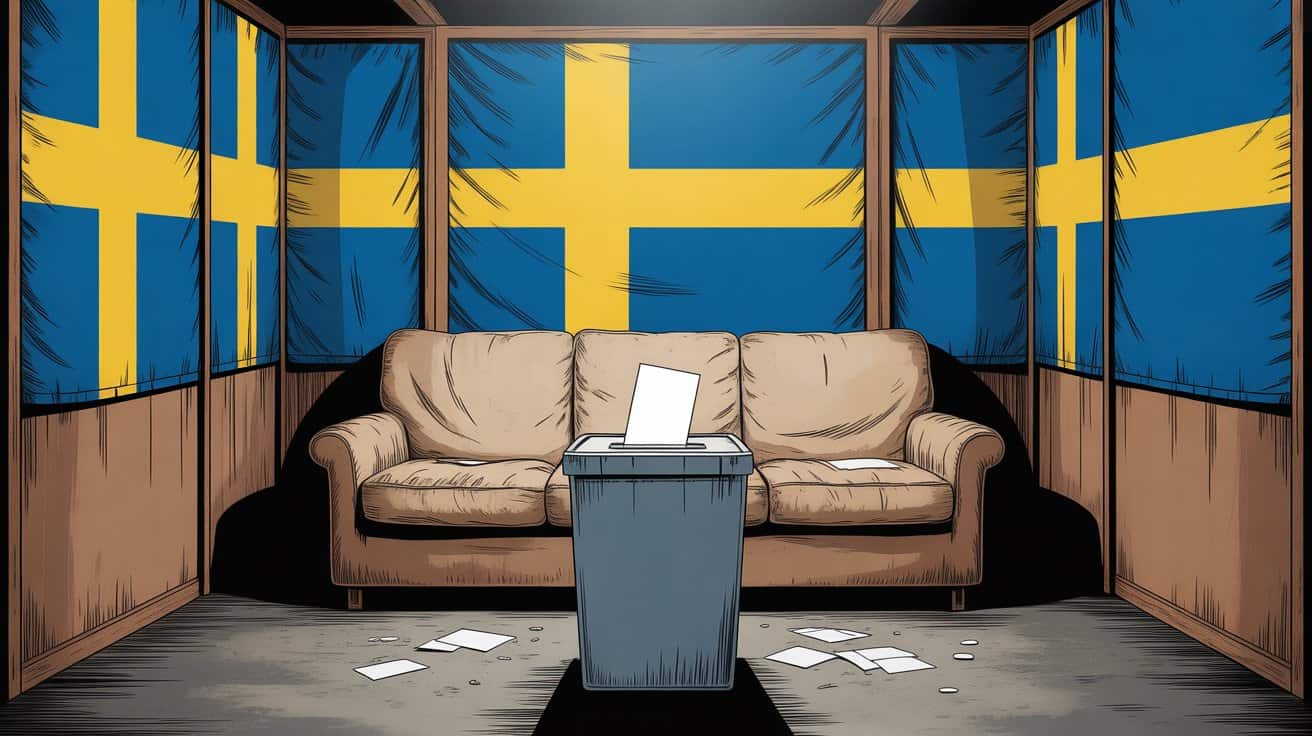
Voices: ‘Why I stopped voting’ .Three voters from three different generations explain why they’ve lost faith in the Riksdag.
Örebro, Sweden-You know the queue at a Swedish polling station. Long. Silent. Dutiful. For decades, voting wasn’t really a choice. It was a reflex. To be Swedish meant to vote.
Now look at the places where the queues have disappeared. Concrete courtyards in “Million Program” suburbs.
Quiet gravel driveways in the rural interior. A new kind of silence grows. The silence of the soffliggare-the “couch sitters.” But they aren’t lazy. They’re protesting.
Democratic exclusion.
They call this demokratiskt utanförskap(Democratic exclusion). Not apathy. An active rejection of a system that many feel has already rejected them.
Fresh numbers from Statistics Sweden confirm the trend. In the 2022 election, turnout dropped to 84 percent. High by global standards. But a warning bell for Sweden. In some “vulnerable areas,” barely half of adults voted.
Who are the ones staying home? We present three of them.
The Numbers Tell The Story
The drop isn’t random. It follows a pattern.
Statistics Sweden shows the gap between people born in Sweden and people born abroad is now over 20 percentage points. Among first-time voters, the steady rise in participation has stalled.
The “trust gap” widens. People with low trust in others increasingly opt out of the political system entirely. Or drift toward anti-system voices.
But for many, the choice is simply silence.
The Climate Pessimist
Linnéa(Not her real name), 22, student in Uppsala.
Linnéa voted in 2022. Her first time. She marched for the climate. Believed the promises of a “green transition.”
“I grew up hearing that Sweden was the moral superpower,” she says. Staring at her phone where news of another missed climate target flashes by.
“But I watched the last government. Now this one. They change the logos. The factories keep pumping.”
For Linnéa, political language has become a dead language.
“They talk about ‘budget discipline’ and ‘security zones.’ I’m worried about whether I’ll have a planet to live on. Or a pension to retire to.
They fight over tax cuts for people who already own boats. I don’t see a ballot paper.
I see a permission slip for them to do nothing.”
The ‘Problem’ to be Solved
Amir (Not his real name) 41, taxi driver in Malmö.
Amir came to Sweden fifteen years ago. Learned the language. Speaks arabic to his kids at home, but flawless Swedish to passengers and others in society. Built a life. Used to vote Social Democrat (S). Then Moderate (M). Now? Votes for nobody.
“Turn on the TV,” Amir says. Gestures to the radio in his cab. “When they talk about people like me, what do they say? Gangs. ‘Integration debt.’ They talk about me like I’m a leak in a boat that needs plugging.”
Amir feels no party speaks to him. Only about him.
“I work sixty hours a week. My back hurts. I pay taxes. But in the Riksdag(Swedish parliament), I’m not a citizen. I’m a statistic in a debate about crime.
Why would I vote for a system that only sees me as a threat?”
The Abandoned Loyalist
Bo (Not his real name) 68, retired forester in Värmland.
Bo voted in every election since 1976. Center Party member for twenty years. Remembers when the local municipality had power. When decisions got made at the village hall.
“It’s gone,” Bo says. Points at the closed medical center down the road. “Stockholm decides everything now. They put up wind turbines here to power their Teslas in the city. Then they close our maternity ward.”
Bo sees the political class as a different species. Urban professionals who’ve never held a chainsaw. Never waited three hours for an ambulance.”
They come here every four years,” he says. Pours strong coffee. “Wear a helmet. Take a picture at the sawmill. Then leave. I stopped voting because I realized my X doesn’t count.
The map they use in Stockholm doesn’t even have my village on it.”
The Government’s Answer: ‘Information Campaigns’
The government is worried. For the 2026 election, they’re launching a massive “Get Out the Vote” campaign.
Printing brochures in fifteen languages. Hiring “democracy ambassadors” to go into the suburbs. Running ads on TikTok for people like Linnéa.
Critics say this misses the point. The problem isn’t that Linnéa, Amir, and Bo don’t know how to vote. It’s that they don’t see why they should vote.
Back to the Two Pictures
So back to the polling station.
Old picture. The queue was a line of people who believed they were building a society together. The state was a tool they could use.
New picture. The queue is shorter. The people left outside-the young idealist, the hardworking immigrant, the rural pensioner-have realized the tool is broken.
The silence of the soffliggare asks a dangerous question for 2026.
Is a democracy still a democracy if the people who need it most have stopped believing in it?
Leave a Reply