How European churches are fighting over cryptocurrency, morality, and financial survival.
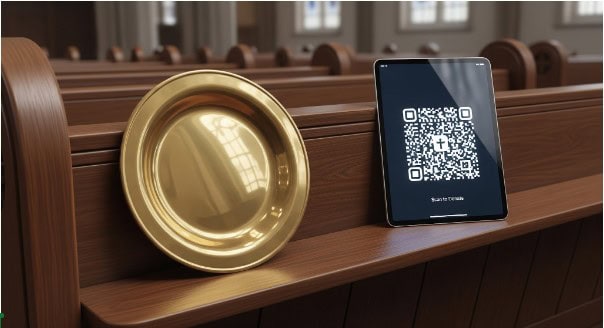
Vienna, Austria – You know the Sunday collection. Polished brass plate moving down wooden pews. People drop coins and paper notes. Metal clinks. Slow, quiet, ancient.
Now picture the service at Saint Hedwig’s today. The plate still goes around. But the pastor also holds up an iPad. Flashes a digital QR code.
A 72-year-old woman named Frau Schneider (Not real name) whispers in shock. Thinks it’s absurd. Behind her, a young trader scans the screen with his phone. Sends €500 in a digital currency called Ether before the choir finishes singing.
This shift tears church leadership apart. Physical money is drying up. The digital world is flooded with wealth. The church sits in the middle, trying to decide if this new money is a blessing or a sin.
Fresh numbers show a massive divide. Old cathedrals struggle to pay for heating. Billions of euros sit in digital wallets of young believers.
How did computer code become theology’s newest battleground?
The Numbers Tell The Story
Math forces the issue.
European Central Bank, 2024. 14 percent of Europeans now use cryptocurrency. Not a fringe hobby anymore. Massive financial system. Researchers estimate over €9.3 billion in potential annual donations locked in these digital wallets.
The Church watches traditional donors age and disappear. The younger generation holds wealth differently. Reverend Dr. Elinor Sørensen wrote in 2023 that money is just a story.
The Church refuses digital money, she argues, they abandon youth to pure greed.Simple truth. The Church refuses to speak the financial language of the next generation.
The Trader and The Traditionalist
Not just about banking. About trust.
Meet Felix(Not real name).Twenty-eight years old. Makes a living trading digital coins. Doesn’t carry cash. Goes to church, wants to give the way he earns.
“My money is digital,” Felix says. “Moves instantly. Efficient. If the church only wants paper, they don’t want me. They live in the past.”
Now meet Frau Schneider(Not real name). Gives a paper note every week. Trusts what she can touch. What the government prints.
“Next they’ll want to baptize us on a computer,” she says, watching Felix. “Not holy money. Gambling money. Hidden from taxes.”
Felix and Frau Schneider sit in the same building. Different financial realities entirely.
The Helsinki Miracle and The Vatican Warning
Debate exploded in Helsinki in 2022. Luther Church received an anonymous Bitcoin donation. Worth €20,000.
Old guard got angry. Cardinal Jean-Claude Hollerich condemned it. Called it “tax evasion sanctified.” Dirty money entering a holy place.
But Bishop Jukka Keskitalo took a different path. Kept the money. Used it immediately to house refugees fleeing war. Called digital cash “modern providence.” Used invisible wealth to fix a very visible human crisis.
Experiments spread across borders.
Zurich. St. Jakob parish accepts twelve different digital coins. Use funds to train refugees in computer skills. Global reach is instant. A believer in East Africa can send a donation to Europe in seconds. No bank fee. “Digitalt offer,” they call it in Swedish. A digital offering.
Even in Greece. Orthodox monks on Mount Athos use water power to mine Bitcoin. Call it turning electricity into charity.
The Data: Fear vs. Survival
Despite experiments, fear runs deep.
Lutheran World Federation surveyed 780 clergy in 2024. Deeply divided leadership.
Over two-thirds of priests – 68 percent – believe cryptocurrency enables tax fraud. Remember Vatican warnings. If Judas betrayed Jesus today, he’d use untraceable digital coins.
Yet same priests look at empty pews. More than half – 57 percent – admit digital tithes are the only way to reach youth.
Caught between fear of dirty money and reality of bankruptcy. Innovators try to build “ethical ledgers” to track funds and keep them clean. Suspicion remains.
Back to the Two Pictures
So back to the collection plate.
Old picture. Church knew exactly where money came from. Local village pockets. Safe. Physical. Known.
New picture. Money falls from the digital cloud. Anonymous. Volatile. Complicated.
Church blessed the printing press. Radio. Television.
Question for 2026 is simple…
Can a holy institution survive on invisible money without losing its soul?
Leave a Reply