How Europe’s empty churches became the frontline for Ukrainian refugees
Warsaw, Poland – You know the traditional European cathedral. Built for silence. Tourists take photos. Elderly people light candles. Beautiful. Rigid. Mostly empty.
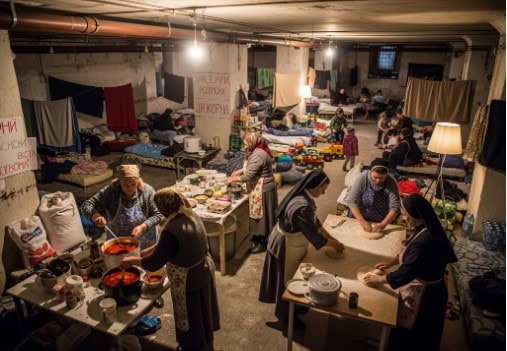
Now, picture the basement of a Franciscan church in Warsaw today. Loud. The air smells of borscht, pierogi, and wet winter coats. Grandmothers from Lviv knead dough beside nuns.
A 1962 baptismal certificate from Kharkiv isn’t a historical artifact. It’s a passport. The document that unlocks a mattress on a concrete floor.
This shift has a name. Sanctuary logistics!
When war began, formal state systems buckled. Borders are overwhelmed. In that chaos, the oldest, emptiest buildings in Europe threw open their doors. Turned a dying religious model into a massive, life-saving machine.
New data from 2024 reveals a shocking reality. The church is doing the heavy lifting of the European welfare state.
How did a fading institution become the most effective refugee agency on the continent?
The Numbers Tell The Story
UNHCR data paints a clear picture. Since February 2022, European churches have sheltered over 1.2 million Ukrainian refugees.
Not just a roof. A network.
World Council of Churches 2024 impact study numbers are staggering. Grassroots faith initiatives provided 18.7 million shelter nights. Secured over 112,000 jobs. Delivered more than 650,000 trauma counseling sessions.
Results are measurable. Refugees assisted by church networks have a three times higher rate of long-term resettlement success. UNHCR says 76 percent of these refugees cite faith communities as their primary support network.
Simple truth. The state prints visas. Parishes provide survival.
The Worker and The State
Not a story of polished bureaucracy. Desperate improvisation.
Meet Sister Irena. Not real name. Works in a refectory in Kraków. When trains started arriving from Przemyśl, her parish transformed overnight. Wooden pews became beds. Confessionals became makeshift clinics for volunteer doctors treating shrapnel wounds. Altar became a 24-hour kitchen.
“We turned liturgy into logistics,” Sister Irena says. Handing out bowls of soup. “Distributing bread was the Eucharist. We’re baking communion that fills stomachs before it fills souls. It’s a true kimbilio(A true sanctuary)”.
Now look at the government response. Politicians praise churches in the press. Financial reality is cold. Caritas Europa data says governments cover only 18 percent of these grassroots support costs.
Sister Irena and thousands of volunteers work around the clock. The state is happy to let them. Governments have effectively outsourced a massive humanitarian crisis to underfunded, aging parishes.
The Hidden Cost of Mercy
Europe’s architecture gets repurposed.
Dortmund. A Lutheran church welded unused organ pipes into bunk beds.
Romania. Monks erected geodesic domes in vineyards to house families.
Strasbourg. A cathedral attic that once held medieval robes now houses 30 refugee artists.
But the system breaks. You can’t run a crisis response on charity forever.
A 2024 study in the Journal of Religion and Health exposed the dark side. Among pastoral caregivers and volunteers running shelters, 62 percent show severe PTSD symptoms. Absorbing horror second-hand. Listening to stories of Bucha.
Managing the fact that 55 percent of refugees report a profound crisis of faith after witnessing atrocities.
Workers burn out. Funds run dry. War doesn’t end.
Back to the Two Pictures
So back to the church doors.
Old picture. Church was a museum of quiet, dying faith. The door’s heavy. Often locked.
New picture. Church is a chaotic, loud hospital for the living. Doors taken off hinges.
The state relies on this miracle to keep the crisis invisible.
But 2026 reality asks a dangerous question…
What happens to refugees when the people holding up the roof finally collapse from the weight?