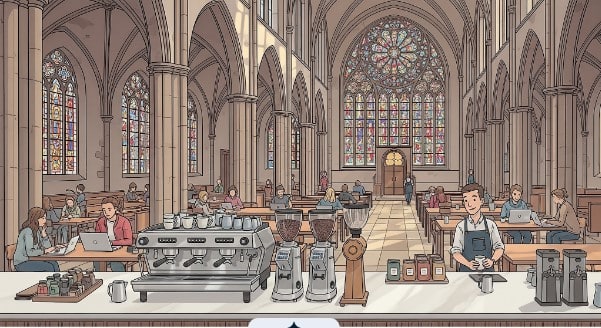
How a failing institution traded stained glass for espresso machines to survive.
Berlin, Germany – You know the old European church. Stone walls. Quiet. Dust and old books smell. A priest speaks to a few old folks in wooden pews. Beautiful monument. Mostly empty.
New church. An old brewery in Berlin
Now picture the new church. An old brewery in Berlin. Steam rises from a commercial espresso machine. Roasted beans smell. Young people sit at wooden tables. Laptops open next to Bibles. The holy lives in the grinder’s hum.
They call it the café church. A desperate move to save faith in cities where traditional religion is dying.
For centuries, the church was the community’s center. Today? Mostly ignored. But a new movement is building an altar out of the coffee counter.
Fresh numbers show the collapse. Old model failing fast.
How did the espresso machine become the new focal point for European faith?
The Numbers Tell The Story
Research groups paint a grim picture.
Pew Research Center looked at urban Europeans aged 18 to 35. 2023 study. Found that 78 percent see traditional churches as culturally alien. They don’t feel they belong.
France’s IFOP polling group, 2024 data. Only 14 percent of young French Catholics attend mass once a month. Seminary-trained pastors preach to silver hair. Young people look for community elsewhere. Yoga studios. Co-working hubs.
Simple truth. Cathedrals are turning into museums.
The Pastor and The Roaster
Desperation drove this change.
Meet Dr. Markus Schmidt. Lutheran pastor in Berlin. 2016, his parish had just 19 regular worshippers. Average age 71. In his 2022 memoir, Brewing Resurrection, he admitted the truth. Called himself a hospice chaplain for a dying model. Nearly quit.
Then he took a gamble. Mortgaged his own home. Rented a failed café in Prenzlauer Berg. Created KaffeeKirche(coffee church). Coffee sales pay for refugee housing. Sermons happen over steaming milk pitchers.
Not just Germany. Spreading to London. Paris. Lisbon.
Meet Jean-Paul. Refugee from the Congo. Head roaster at Résurrection Roasters in Paris. Found shelter there while waiting for asylum papers. Now the roasting machine is his pulpit. “Imani inaokoa,” he says in Kiswahili. Faith saves.
He roasts beans to fund beds for other migrants. Secours Catholique report says this café model funded 8,000 shelter beds last year.
The Vatican’s Answer: ‘Defend the Sacred’
Religious establishment sees a problem. The sacred is getting lost.
Cardinal Alfonse Rossi represents old Vatican power. February 2024, he wrote a harsh critique in L’Osservatore Romano. Condemned the café model. Argued sacraments need sacred space. Stated clearly that Christ is not a flat white.
Traditionalists say making church comfortable makes it cheap. Innovators disagree. Pastor Schmidt points out Jesus did miracles at a wedding party, not a temple. Divine can erupt in the ordinary.
One side wants to protect ancient walls. Other side wants to tear them down to find the people.
The Public Feeling
Young people vote with wallets and time. Numbers show coffee shops winning.
Lausanne Movement tracked 62 café churches in a 2024 study. Results clear. State churches? Young people are a tiny fraction. Café churches? 62 percent of attendees are under 35.
Also, nearly three-quarters of these spaces fund themselves entirely by selling drinks. No state taxes. No church headquarters.
Theologian Dr. Anika Löwe studied this shift for her 2023 book, Third Space Ecclesiology. Notes that founders cracked the code for modern community. Faith isn’t dead. It was just waiting for reinvention.
Back to the Two Pictures
So back to the two spaces.
Old picture. Church waited in silence for people to come to the altar. Space stood separate from daily grind.
New picture. Altar pushed out onto the noisy street. Coffee machine is the center. Barriers gone.
Empty pews ask a simple question. Is a church defined by the building it sits in? Or the people who sit at its tables?
Cathedrals lock their heavy wooden doors. Cafes turn on the open sign.